
Greeley, CO · Garage Door Service
Why Your Greeley Garage Door Isn't Built for This Cold
Most Greeley homes went up between 1975 and 2012 with builder-grade steel doors. Here's what that means for springs, panels, and openers once severe cold sets in.
- Repairs & new doors
- Springs & openers
- Serving 5 nearby communities
Where People Go Wrong
A lot of advice about garage doors assumes a house from the 1940s or 50s - thin panels, no vapor barrier, hardware that's been replaced twice already. That's not what's sitting in most Greeley driveways. Housing in this service area was mostly built between 1975 and 2012, with the median landing around 2002, and the dozen areas we cover skew heavily toward 2000s construction. So the door you've got is probably the original builder-grade unit that came with the house, not something cobbled together over decades.
That matters because people troubleshoot the wrong problem. They hear a door is noisy and assume it's old and worn out, when really it's a 20-year-old steel door that was never insulated in the first place, running on hardware sized for a mild-weather spec sheet. Pulling tips off older-home guides leads homeowners to replace rollers or re-grease a track when the real issue is a door shell that was never built to hold heat or flex well in a hard freeze. Knowing your house is a 2000s-era build, not a mid-century one, changes what you should actually check first.
What You Pay
We're not going to put a number here we can't back up - pricing depends on what's actually wrong, the door size, and whether parts need to be special-ordered, and quoting a flat figure without seeing the door would be guessing. What we can tell you is what drives the cost up or down in a town like this one.
Because most doors in the area are from the same 1975 to 2012 construction window, a lot of jobs involve matching hardware to a door that's 15-40 years old, not brand new stock. That can mean a longer wait on a specific panel or track section than a straightforward spring swap. Household income across the service area runs a median of $103,356, which is relevant mostly in that most homeowners here are replacing a door that still has useful life left in it rather than tearing out a failing structure - repair over replacement is usually the right call unless the door itself, not just the hardware, has failed. Ask for a number after a look at the actual door, not before.
The Problem
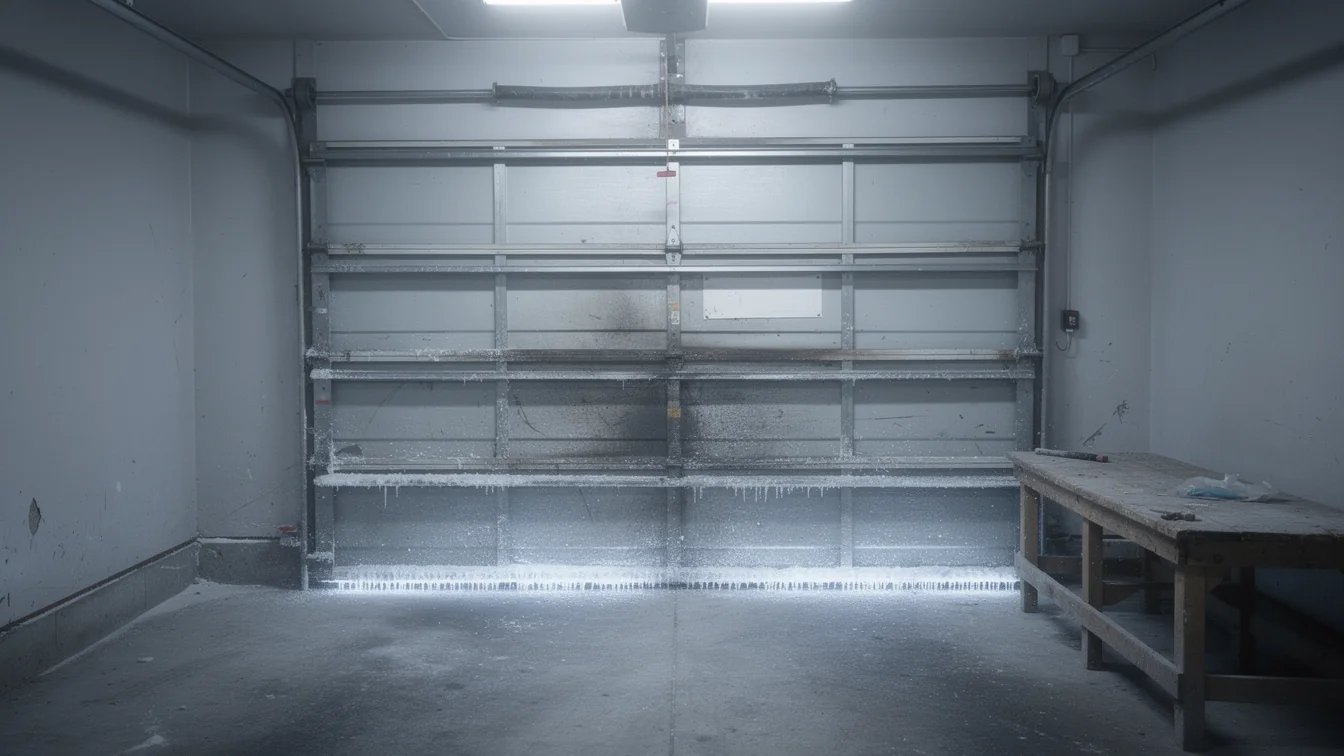
Builder-grade doors from the 1975-2012 window were priced to spec, not to perform in a severe winter. A huge share of what went up in that stretch is single-layer steel with no insulation core - fine for a mild climate, not fine once temperatures drop hard and stay there. Steel contracts in the cold. A door that fits its track fine in July can bind or rattle in January because the panel has shrunk slightly and the alignment that worked at 70 degrees doesn't work at 10.
The spring is usually the first thing to show it. Torsion springs on these builder units were sized for the weight of an uninsulated panel in a temperate cycle, and cold steel is harder on the coil with every open-close cycle. Openers take a hit too - the chain or belt doesn't care, but the sensors and the gear assembly inside a cheap unit from this era often weren't rated for consistent sub-freezing operation. None of this means the door is junk. It means it's doing a job it wasn't really specified for, and once you know that, you stop chasing the wrong fix.
What the Weather Here Does to It
Greeley sits in a severe cold climate band, and that's the piece that turns a builder-grade door from an inconvenience into a recurring call. Cold doesn't just make steel contract - it stiffens lubricant on rollers and hinges, slows opener gear response, and makes a torsion spring that's already sized tight for an uninsulated panel work harder on every cycle. A door that's marginal in October usually becomes a problem in a hard cold snap, not gradually.
If you're out toward Severance, seven miles up, or Eaton, eight miles out, you're dealing with the same housing-era and climate combination as anyone closer into town - this isn't a problem specific to one neighborhood, it's specific to the build year and the winters. The honest answer is that insulating an old non-insulated door after the fact helps some but doesn't fix a spring sized wrong for the panel weight - sometimes the fix is accepting the door for what it is and servicing the hardware more often through the cold months rather than chasing a full retrofit.
Frequently asked questions
Is my garage door too old to be worth fixing?
Not necessarily. Most doors in this area came with houses built between 1975 and 2012, so a lot of what we see is 15 to 40 years old - old enough to need hardware work, but usually not old enough that the door shell itself is the problem. We'd want to look at it before saying replace versus repair.
Why does my door get noisy only in winter?
Steel panels contract slightly in severe cold, and track alignment that's fine in summer can bind once temperatures drop. Builder-grade doors from the 1975-2012 era weren't always insulated, so they're more exposed to this than a newer insulated door would be.
Can you give me a price over the phone?
Not honestly, no. Cost depends on the door, the part, and whether we need to special-order hardware to match an older panel. We'd rather look at it first than guess at a number that turns out wrong.
Do you serve areas outside Greeley itself?
We cover the surrounding area, including towns like Evans, Severance, Eaton, Milliken, Windsor, and several others within roughly a 15-mile range of Greeley.
Related garage door services in Greeley
More garage door guides
Book garage door service in Greeley
Call now or request a quote - tell us what the door is doing and where you are.